
Benjamin Segobaetso – Local Journalism Initiative
Published online October 21, 2026, at www.pontiacjournal.com
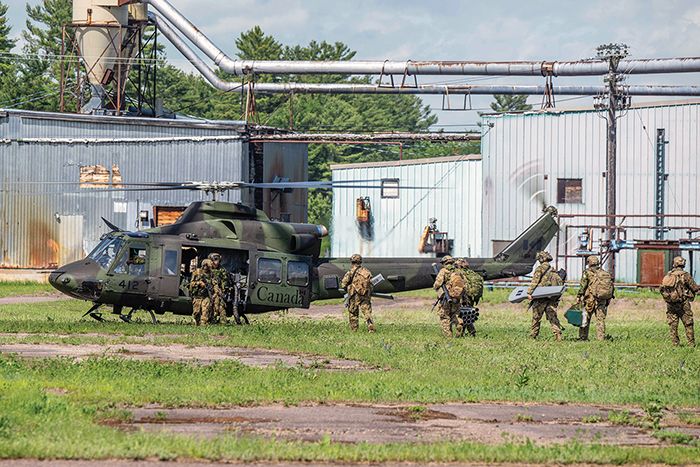
PONTIAC – Griffon and Chinook crews take on simulated enemy forces as RCAF brings realistic combat training to Pontiac’s forests and farmland. For the next several weeks, parts of Pontiac will become a tactical training ground as Canada’s military aviators prepare for the challenges of modern warfare. Military helicopters will be flying low over forests, troops manoeuvring through unfamiliar terrain, simulated enemy forces and the sounds of battlefield pyrotechnics will be active.
From October 13 to November 10, the Royal Canadian Air Force (RCAF) is conducting Basic Tactical Aviation Course 2602, bringing CH-146 Griffon and CH-147F Chinook helicopters into the region for demanding exercises designed to test pilots’ leadership, tactical judgment and ability to coordinate complex military operations.
The operation involves eight pilot candidates, six tactical aviation intelligence candidates and approximately 220 supporting RCAF personnel, alongside Canadian Army troops from the 3rd Battalion, The Royal Canadian Regiment. For these military aviators, Pontiac’s rugged countryside is not simply a scenic backdrop. Its forests, isolated landing areas and unfamiliar terrain present the kinds of operational challenges crews must learn to overcome.
Lieutenant(N) Meagan Pye, Public Affairs Officer at 1 Wing Headquarters in Kingston, affirmed in an answer to Pontiac Journal’s questionnaire underlining that; “the Pontiac region provides a realistic and complex training environment that supports the objectives of Basic Tactical Aviation Course 2602.” The exercises will challenge pilots to plan and lead missions involving multiple helicopters while coordinating with ground forces. Intelligence candidates will assess simulated threats, analyse battlefield conditions and provide information to support tactical decisions.
Residents may witness Griffon helicopters conducting reconnaissance and mobility missions while powerful Chinooks practise transporting troops and heavy equipment. The Griffon can also provide armed support when appropriately configured, while both aircraft are capable of supporting casualty evacuation operations.
Simulated enemy forces add battlefield realism
On the ground, military personnel will participate in simulated operational scenarios involving friendly and opposing forces. Residents may encounter simulated enemy personnel wearing orange hunting caps and reflective armbands. Training weapons will be clearly marked and fitted with blank-firing adapters. Controlled flares, smoke effects and blank ammunition will add realism to the exercises, allowing personnel to practise coordinating aviation and ground operations under simulated battlefield conditions. Despite the military activity, Pye emphasized that public safety remains paramount. All operations will take place in authorized training areas under qualified supervision, with blank ammunition restricted to designated locations. Helicopter flights will occur during daylight hours, with no night operations scheduled.
Pontiac landowners answer the call
Behind the tactical manoeuvres is an important civilian contribution. Several Pontiac landowners have voluntarily opened their properties to the Canadian Armed Forces, providing unfamiliar operating environments that military training grounds cannot always replicate. “The support of Pontiac landowners and communities is vital to the success of this training,” Pye said.
Their cooperation allows aircrews to develop critical thinking, adaptability and leadership skills in realistic conditions. The RCAF also hopes the exercises will spark interest among young residents considering careers in military aviation, intelligence and the Armed Forces. Although future training locations have not been determined, the current exercises demonstrate the value of Pontiac’s landscape and its residents to Canada’s military preparedness. For the crews overhead, every reconnaissance mission, simulated threat and unfamiliar landing area represents another opportunity to sharpen the skills required for operational deployment.
For Pontiac, the coming weeks offer a rare front-row view of military aviation training and an opportunity to contribute directly to preparing the men and women who may one day be called upon to serve Canada in demanding operations around the world.