Cathy Fox
Published online March 11, 2026, at www.pontiacjournal.com.
FORT-COULONGE – More than 20 participants–community members and representatives from regional organizations–met at the Pontiac Conference Centre, February 4, for a consultation organized by the Canadian Parks and Wilderness Society–Ottawa Valley (CPAWS-OV) to gather input on the future development of a proposed biodiversity reserve in the Noire and Coulonge rivers watershed. The session is part of ongoing work to develop a plan for the recently announced protected area.
Efforts to protect the watershed date back nearly a decade. In 2016, shortly after contributing to the protection of the Dumoine River, CPAWS-OV began compiling information on the Noire and Coulonge rivers with the goal of creating a connected network of protected areas.
An initial proposal was rejected, but the project was revived in 2022 when CPAWS-OV and the Conseil régional de l’environnement et du développement durable de l’Outaouais (CREDDO) were mandated to draft a second proposal. On Aug. 30, 2023, the Quebec government officially announced the designation of 852.6 square kilometres of the Noire and Coulonge watershed as a reserve, with the eventual goal of granting it full biodiversity reserve status.
During the workshop, participants watched a presentation by CPAWS-OV vice-president John McDonnell outlining steps taken by the volunteer citizens’ group Friends of the Dumoine River. Their work to help protect and promote the Dumoine River was presented as a potential model for launching the new project.
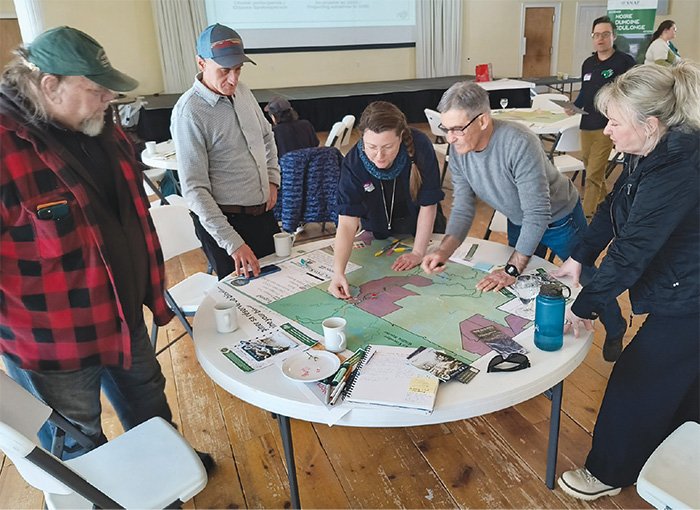
Attendees then broke into small groups around tables covered with maps of the proposed reserve area. Participants used coloured stickers to mark locations of interest, concern or areas that should be avoided, adding notes explaining their choices.
A second exercise invited participants to list “treasures,” concerns and a vision for the watershed in 2050. These ideas were grouped under three themes: natural assets, historical assets and governance factors. Each table later identified key priorities and selected a spokesperson to present their ideas to the larger group.
Despite the informal format, several common themes emerged. Participants stressed the importance of consulting with local communities to ensure infrastructure and emergency services can support increased tourism generated by the new reserve. They also highlighted the need for stable funding, clear and well-researched operational guidelines, local hiring and the preservation of historical knowledge held by elders.
Using the feedback gathered during the session, CPAWS-OV plans to identify major challenges and opportunities before developing an action and monitoring plan. The organization hopes the plan can be implemented by the end of 2027.
Participants suggested the next gathering take place within the watershed itself, with canoes and kayaks, to allow stakeholders to experience the area firsthand.
The initiative is one of four sites selected by Quebec’s Ministry of Tourism and the Ministry of the Environment, the Fight Against Climate Change, Wildlife and Parks for a “pilot project for the development of biodiversity reserves to promote responsible and sustainable tourism” funded through the province’s 2020–2025 Responsible and Sustainable Tourism Action Plan.
Photo – Participants mark areas of interest on maps during a February 4 consultation in Fort-Coulonge on the proposed Noire and Coulonge watershed biodiversity reserve. (CF)