Fred Ryan
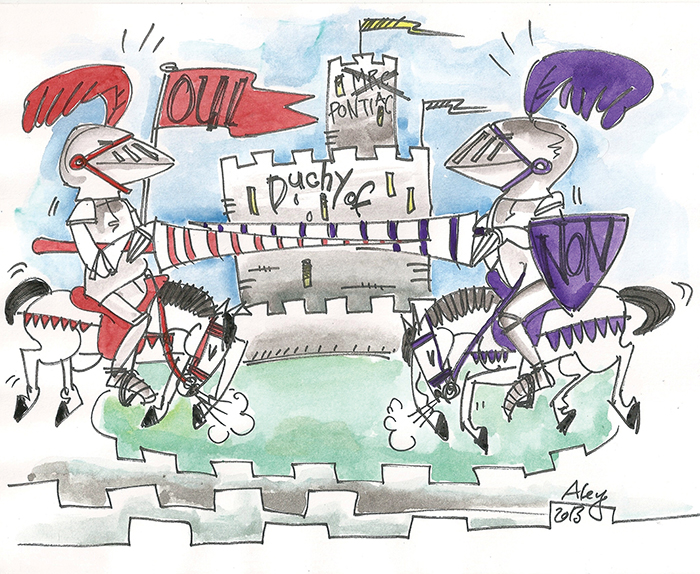
This edition completes our capsule of one particular high spot in the Pontiac Journal’s 40-year life: the Journal’s proposal to create a British Duchy, covering all of the Pontiac, as a tongue-in-cheek response to Quebec’s independence movement, which was then gaining strength. Canada (including Quebec) was still part of the British Commonwealth and as Queen’s University law students association confirmed, the British crown still had the power to create a Duchy anywhere within its realm. This movement was the brainchild of the MRC-CLD’s Marc Corbeil, Waltham’s John Evans, and me, the Journal’s publisher-editor. Plus hundreds of supporters!
Separatists and Quebec’s then-government took the movement seriously; hundreds signed a pro-Duchy petition, and the media across Canada — and into Europe — reported the phenomena as a serious political movement. There were public meetings, small rallies, and plenty of letters to the editor on the subject. Public opinion ranged from humour to serious support, small donations, to offers to host kitchen parties, church hall rallies and debates.
Then, in Quebec’s actual October 30, 1995, independence referendum, the independence separatists lost by a small margin.
With the narrow victory of the pro-Canada side, the issue lost steam, although some groups, such as one in Fort William on Allummettes Island, tried to keep the concept alive — after all, the separatists were promising to try again. With a bit of deja-vu, in 2026, the poll-leading PQ party has promised another referendum (once Trump is out of power!).
This quick summary hardly does the story justice for the Journal’s role, but does demonstrate the influence that local media can yield, especially in rural areas with fewer distractions than urban zones.
The three originators of the Duchy movement had from the start a clear idea that a movement or campaign like this could yield benefits to tourism in particular.
For generations, local governments have tried to stimulate tourism — the Pontiac sits within driving distance of several large markets, besides Ottawa — Montreal, Toronto, and upper New York. We have promoted our region as a natural paradise (which it still is), a fishing and hunting mecca (which it still is), a boating, cottaging and camping locale (which it still is), even a dark-sky region with back-to-the-land settlement space (which it still has).
A pleasure-boaters’ waterway up the Ottawa River, white-water adventure sites, a forestry paradise, and hikers and cyclists’ heaven.
We thought, at the time, “wouldn’t a ‘Duchy of the Pontiac’ give our region an identity ahead of most regions across Canada? Wouldn’t a Duchy open up a new genre of tourist attractions’ — medieval tournaments, royalist fairs and feasts, horse-racing, even a new genre of facilities attracting tourists — castle-and-fortress-like accommodations, a feasting hall or two — the list was limited only by our imaginations.
One cartoon that appeared in the Journal back then (by teenager Blaise Ryan) showed a huge traffic jam on Highway 148 as tourist cars and campers headed to a local “castle” (was the castle located in Ladysmith?). Athletic events (jousts, sword fighting), feasts of barbequed Pontiac boar, parades, and all the fun that these imply. Much more attractive, we speculated, than standing staring at a river going over a ledge — like Niagara! And, side-stepping the battles and hard-feelings the separatist-independentist movement was spawning.
What other benefits would come to this region, one of Canada’s most unspoilt? All this kick-
started by local media!
This public debate represented the Journal’s commitment to positive journalism, and addressed the value of local media to our community. It suggested what we could expect of independent media acting with our best community interests at heart.
Viva le Duchy du Pontiac!