

Benjamin Segobaetso – Local Journalism Initiative
Published online September 9, 2026, at www.pontiacjournal.com
CAMPBELL’S BAY – Quebec Environment Ministry officials told the BAPE commission they
generally agree with Samonix’s interpretation of how wastewater from its proposed land-based salmon farm would affect the Ottawa River, even as Pontiac residents continued to press government experts over drinking-water safety, environmental monitoring and emergency safeguards.
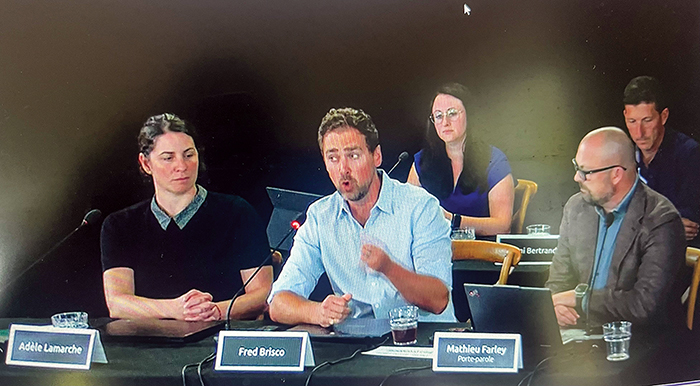
The exchange came during the Bureau d’audiences publiques sur l’environnement (BAPE) hearing into Samonix’s proposed aquaculture facility in Litchfield, held at the Campbell’s Bay RA August 25-26.
Much of the hearing focused on what would happen to treated wastewater after it is discharged into the Ottawa River. Samonix technical director Fred Brisco told commissioners that chloride would be discharged at approximately 640 milligrams per litre but would rapidly dilute after entering the river. According to the company’s modelling,
chloride would fall to approximately seven milligrams per litre after 30 metres before reaching the Ottawa River’s natural background concentration of approximately
1.5 milligrams per litre at 90 metres.
Environment Ministry representative Victor Duchesne told the commission, “We have more or less the same interpretation as what the project proponent has just stated.” He was then asked whether compliance with the environmental discharge objectives would adequately protect Portage-du-Fort’s downstream drinking-water intake. “Yes, exactly,” Duchesne responded.
Residents challenge modelling
Despite the assurances, several residents challenged whether computer modelling provides sufficient certainty. Amy Taylor, one of the residents who requested the BAPE review, questioned the project’s reliance on calculated predictions of dilution and “plume behaviour”.
She also questioned changing water-intake and discharge figures that had appeared during different stages of the project.
Samonix acknowledged that earlier versions of the project contemplated greater water use, up to 12,000 cubic meters a day. The project was redesigned to increase water recirculation. The Ministry confirmed that its latest environmental discharge objectives, issued in April 2026, were calculated at 2,372 cubic metres per day.
Cathy Fox, a Portage-du-Fort resident, questioned whether sufficient baseline testing had been conducted to establish existing river conditions before the facility begins operating.
The Ministry responded that it already has considerable information and operates two water-quality monitoring stations near the Samonix site. Officials said they believe sufficient information exists to establish baseline conditions.
Portage-du-Fort drinking water
Drinking-water concerns were particularly prominent from residents of Portage-
du-Fort.
Sylvia Poetschke called for independent, on-site research and argued that computer-generated simulations cannot account for all real-world river conditions.
Linda Davis questioned whether comparable recirculating aquaculture systems have been successfully demonstrated elsewhere at the proposed scale. Davis also raised concerns about a catastrophic failure and what that could mean for downstream communities.
Nicole Thompson, speaking on behalf of the Municipality of Portage-du-Fort, repeatedly returned to the community’s drinking-water infrastructure. She asked whether Portage-du-Fort could receive environmental monitoring information from Samonix.
Environment Ministry representative Mélina Langevin said direct notification to municipalities would be unusual; however, conditions could potentially establish liaison committees.
Public Health sees no drinking-water danger
The Outaouais Public Health Department offered significant reassurances regarding normal operations. Dr. Guillaume Campagné told commissioners that public-health officials had examined chloride closely because they were aware of drinking-water intakes downstream. Campagné cited a Health Canada chloride value of 470 milligrams per litre. While concentrations would initially be higher around the immediate discharge point, he noted that Samonix’s modelling predicts chloride will return to approximately 1.5 milligrams per litre within 90 metres. The Portage-du-Fort intake is much farther downstream.
What happens if something goes wrong?
Thompson also pushed for answers about situations beyond normal operating conditions. She asked what would happen if Salmonix exceeded environmental limits or experienced an accident. Samonix founder Mathieu Farley said the Environment Ministry and MAPAQ have required the company to prepare emergency-response protocols. The facility would have monitoring systems at its discharge point.
Notifications could include the Environment Ministry, MRC Pontiac and potentially Portage-du-Fort or other affected municipalities. The exchange revealed that while an emergency plan exists, an automatic system for informing downstream municipalities has
not yet been established.
Who pays for environmental damage?
Thompson also raised the question of financial liability. She told commissioners that Portage-du-Fort does not have the financial capacity to absorb major unexpected costs if its water-treatment infrastructure was damaged; individual filters can cost between $30,000 and $40,000. Samonix said it would carry appropriate insurance and accept responsibility for any damage it caused.
The Ministry confirmed that Quebec can require financial guarantees from projects undergoing environmental assessment. Such guarantees are more commonly required for mines and landfill sites but officials said this could be examined as part of the project’s
environmental analysis.
The BAPE commission does not approve or reject the project; its mandate is to assess the environmental, social and economic implications and make recommendations to the Quebec government.


