Benjamin Segobaetso – Local Journalism Initiative
Published online October 7, 2026, at www.pontiacjournal.com
CAMPBELL’S BAY — After months of debate over jobs, investment and the future of the Ottawa River, the public arguments over the proposed Samonix aqua-farm reached their final BAPE hearing on September 29 in Campbell’s Bay. Pontiac has spent years lamenting the loss of industry, jobs and investment. Now a company is proposing to spend roughly $418 million, create up to 100 permanent jobs and breathe new life into an industrial site in Litchfield.
But as the Bureau d’audiences publiques sur l’environnement (BAPE) wrapped up its hearings on the project, a more uncomfortable question hung over the room, who gets the economic rewards, and who carries the environmental costs and risks?
On one side were some municipal leaders who see Samonix as a potential economic opportunity for a region still searching for industries to replace those lost with the decline of forestry. On the other side, were residents and representatives of downstream communities questioning whether enthusiasm for the project is getting ahead of concerns about the Ottawa River.
Litchfield Mayor, Colleen Larivière argued for the project. “We have not seen a project of this magnitude take shape in our region since the near-total decline of the forestry industry,” she told commissioners. Larivière estimated that the development could put roughly $600,000 to $630,000 annual taxes for municipal coffers, depending on the eventual assessment and tax rate. She informed the commissioners that Samonix is the first major project proposal during her 14 years as mayor to advance this far.
MRC Pontiac Warden, Jane Toller, told the hearings that the mayor’s council supports the project in principle, pointing to its potential for economic diversification, employment, industrial redevelopment and local food production. She told the commissioners that the MRC wants continuing community dialogue and commitments aimed at ensuring Pontiac residents benefit through employment, training and regional procurement.
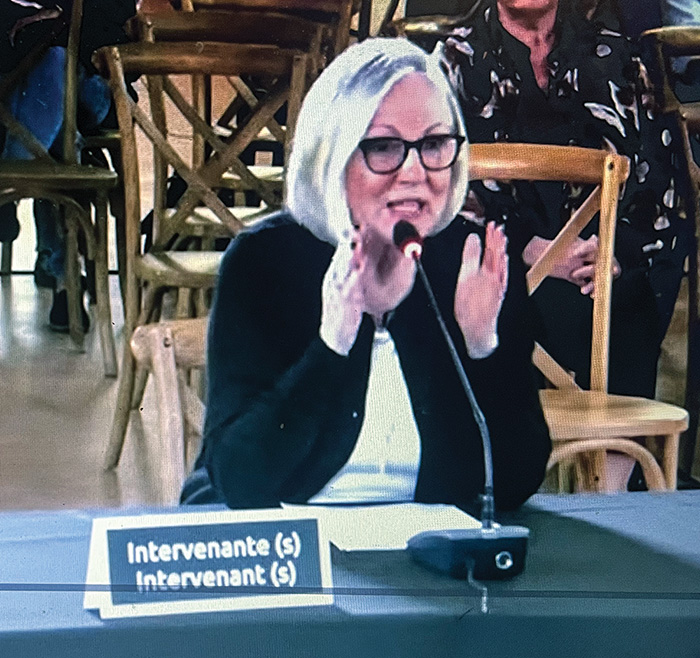
Downstream, Portage-du-Fort sees the economic equation differently. Nicole Thompson, speaking personally and on behalf of the municipality, reminded commissioners that the Ottawa River is Portage-du-Fort’s drinking-water source. “We won’t have the economic benefits of Litchfield,” Thompson told commissioners while questioning whether Portage-du-Fort could instead inherit some of the negative consequences downstream. She affirmed that Portage-du-Fort is against the project. However, she acknowledged that Samonix may proceed but if it does, she wants her municipality treated as a partner, with access to information and a meaningful role in monitoring and communication.
Resident Amy Taylor, who is firmly opposed to the project, shifted the discussion by describing the river as an interconnected freshwater ecosystem already affected by dams, wastewater, runoff, invasive species and habitat alteration. According to project figures she cited, approximately 2,300 cubic metres of treated effluent per day would be discharged, containing phosphorus, suspended solids, ammoniacal nitrogen, nitrates and chloride.
The question, she suggested, is whether today’s modelling can reliably predict what continuous discharge could mean decades from now. She warned that some effects may only become apparent after years or even decades of continuous discharge.
With the September 29 Campbell’s Bay hearing bringing the BAPE public hearings to a close, Pontiac’s arguments have now been put on the record.