William Dale
Published in the Pontiac Journal on May 20, 2026
TNO LAC-NILGAUT – For the owners of Bryson Lake Lodge, the kilometre 54 washout on Chemin du Bois-Franc is more than a hole in the road — it is a critical barrier that contributed to the loss of four cottages during a fire earlier this month. Nearly three weeks after the collapse first forced the closure of the road on April 23, MRC Pontiac officials say repairing the route is far more complicated than simply filling the gap.
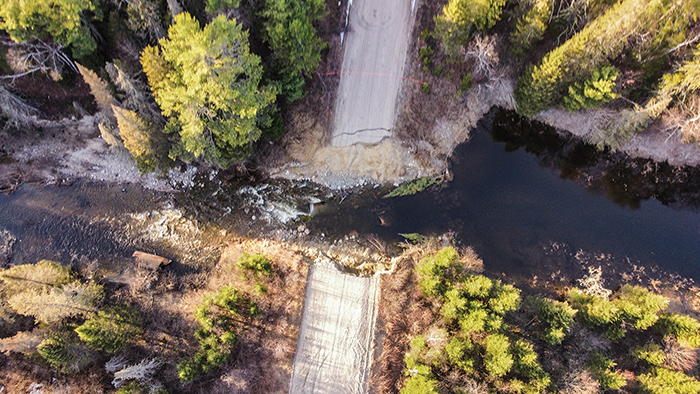
The Ministry of Natural Resources and Forests (MRNF) closed the road after heavy rain and rapid snowmelt overwhelmed the culvert system near the Lac Rousseau stream, washing out the roadway and making the route impassable. At KM 54.8, the collapse created a crater approximately 20 metres wide and 10 metres deep, completely severing the road. Initially, officials warned there was no viable detour around the washout.
The washout later delayed access during the April 30 fire at Bryson Lake Lodge, forcing SOPFEU crews to intervene by helicopter after several cottages and other infrastructure were destroyed.
On May 11, the MRC Pontiac’s territory management team met with the Journal to explain why the repair has become a complex logistical challenge involving environmental regulations, forestry planning and provincial infrastructure funding.
While many residents have questioned why the MRC cannot simply replace the culvert and reopen the road, MRC Land Use Planning Coordinator Matthew Laroche said provincial environmental regulations have significantly changed how repairs must be carried out.
“The road is completely gone,” Laroche said. “With new regulations, it’s not possible to put culverts back there. It has to be a bridge.”
Laroche explained the previous eight-foot culvert no longer meets provincial environmental standards. Flow studies determined that even two 11-foot culverts would violate Quebec’s “20% narrowing rule,” which prevents repairs from excessively constricting a stream’s natural width. As a result, the crossing now requires a bridge rather than a traditional culvert replacement.
A bridge project of that scale could consume most of the MRC’s annual TNO infrastructure budget, prompting officials to pursue provincial grants that could potentially cover up to 90% of construction costs. However, planned forestry harvesting beyond KM 54 complicates eligibility, as roads serving active logging sectors are generally expected to be maintained by forestry companies rather than counties.
“Harvesting was planned by a forest company just past KM 54, which would make us ineligible for those grants,” Laroche explained.
The MRC is now negotiating with the forestry company to remove the affected cut block from its plans in hopes of qualifying for the funding. Even if approved, the project would still need to go through Quebec’s public electronic tendering system (SEAO) because the repair is expected to exceed $100,000. Officials say that means reconstruction will likely take weeks rather than days.
Officials are continuing to urge travellers to exercise caution in the backcountry as spring thaw conditions remain unstable across parts of the TNO road network. Julien Gagnon, the MRC’s public safety and civil security manager, said the northern territory remains weeks behind the south in the spring thaw cycle, leaving roads unstable and conditions difficult to monitor daily.
“Conditions up there are still changing day-to-day,” Gagnon said. “There are still parts of roads with snow on them and very soft spots.”
For those needing access to the north end of Chemin du Bois-Franc, the MRC
recommends using Chemin Schyan via Sheenboro, which provides access toward kilometre 84/86 of the Bois-Franc corridor, including to Fortin Lake Outfitters, Doug Young Outfitters and the northern access points of Bryson Lake.
Officials are also urging travellers to be self-sufficient when entering the TNO. Laroche said changing conditions and remote terrain mean people cannot rely on emergency responders to quickly reach stranded motorists. He recommended travellers carry emergency supplies, extra food and equipment such as a chainsaw or handsaw in case roads become blocked by fallen trees. Officials also advise people venturing into the backcountry to be prepared to spend the night in their vehicle.
“You can’t rely on first responders to come get you if you’re stuck in a mud hole,” Laroche warned. “You have to take matters into your own hands.”
While no official reconstruction timeline has been announced, MRC officials say the plateauing floodwaters are finally allowing crews to fully assess the extensive damage across the territory’s road network.
Photo: An aerial view shows the significant subsidence at kilometer 54.8 of Chemin du Bois-Franc near the Lac Rousseau stream, where heavy rains and spring runoff destroyed the culvert and completely cut off the road. (CL)