Jennifer Haughton
Published online July 15, 2026, at www.pontiacjournal.com.
BRISTOL — Twelve two-year-old Blanding’s turtles raised at the Montreal Biodome were recently released into the wild in Bristol. On June 21, a small group of researchers and volunteers gathered to release the turtles into their natural habitat, where the eggs were originally found. The release was part of the Head Start program, in which turtle eggs or hatchlings are collected, then hatched and raised at the Montreal Biodome for two years to give them a better chance of survival.
The Great Lakes population of Blanding’s turtles is listed federally as endangered, primarily due to habitat loss and road mortality. Many turtle nests are also preyed upon by animals such as foxes, skunks and raccoons. Once turtle eggs hatch, their small size makes the young turtles vulnerable to a wide range of predators.
Blanding’s turtles have been monitored in the Pontiac region for several years through a collaboration involving the Université du Québec en Outaouais, the Conseil régional de l’environnement et du développement durable de l’Outaouais, Quebec’s Ministry of Wildlife and Parks, the Nature Conservancy of Canada and Association du bassin versant des Sept.
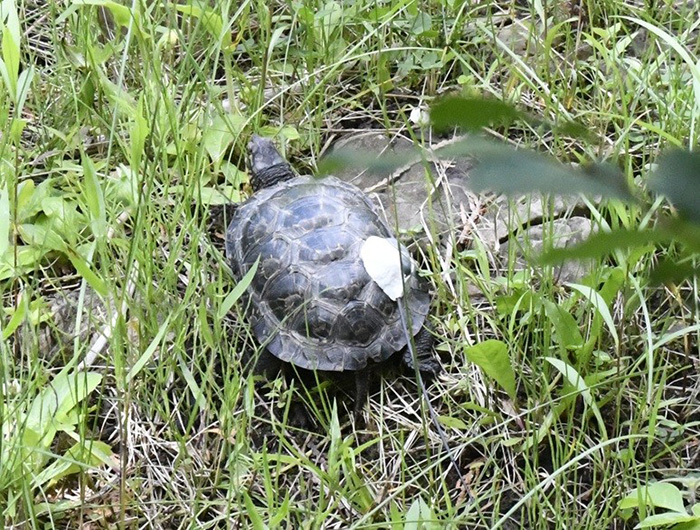
Each turtle was given a name and fitted with a transmitter attached to its shell so researchers can monitor its movements over time. Before release, a photograph of the underside of each turtle’s shell (plastron) was taken. The unique pattern of black blotches on the plastron allows researchers to identify individual turtles.
Of the turtles released, it was not yet possible to determine whether they were male or female. This will become more apparent as they approach sexual maturity between the ages of 15 and 20. Males develop a slightly concave plastron, while females have a flatter plastron.
Following their release, the turtles immediately set out to explore their new habitat, heading into the nearby wetland. Ongoing monitoring and research will help scientists better understand their movements, growth and long-term success in the habitat.
Residents can help by reporting turtle sightings to Carapace.ca. Every observation helps identify hotspots for turtle nesting and road mortality.
Photo – A two-year-old Blanding’s turtle, raised at the Montreal Biodome as part of the Head Start conservation program, heads into a Bristol wetland after being released on June 21. Researchers fitted each turtle with a transmitter to monitor its movements and survival. (Jennifer Haughton)