William Dale
Published online June 3, 2026, at www.pontiacjournal.com.
L’ISLE-AUX-ALLUMETTES — Residents across Pontiac may have noticed CH-146 Griffon helicopters flying low over the region in recent weeks as the Canadian Armed Forces expanded a major aviation training exercise beyond its traditional base at Garrison Petawawa.
The Pontiac region is serving as part of the Basic Tactical Aviation Course (BTAC), an advanced training program that prepares pilots and aircrews for operational deployments. Military officials say the area’s terrain closely resembles parts of Latvia, where Canada maintains a tactical aviation detachment.
“Latvian territory is surprisingly similar to the Pontiac region and the other areas in this immediate vicinity,” said Maj. James Hodgson, commander of A Squadron with the Petawawa-based Royal Canadian Dragoons.
“The neighbouring regions, Pontiac being one of them, provide terrain that is very representative of what our folks would likely be exposed to overseas.”
The current course includes 11 candidates, including three Latvian exchange officers training alongside Canadian personnel. All participants are already qualified military pilots who have accumulated operational experience on aircraft such as the CH-146 Griffon.
“Now they’re brought together with other aircraft and other crews, and they collaborate to plan and conduct missions,” Hodgson said. “The candidates take turns being in command of multiple helicopters within a mission.”
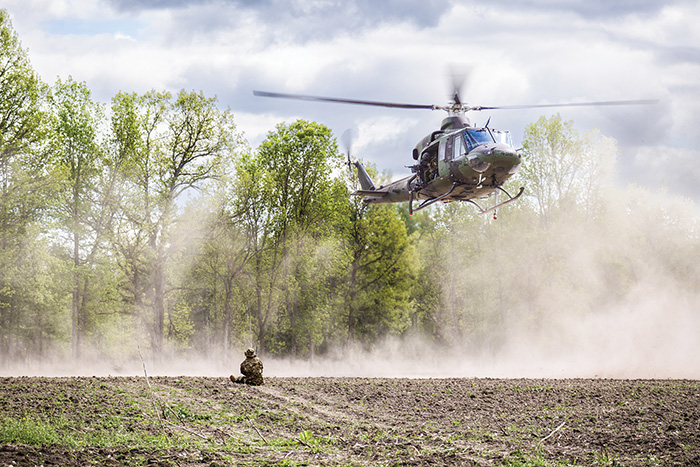
During a recent exercise observed by the Pontiac Journal, crews practised locating and extracting an isolated person separated from friendly forces. To increase the difficulty, the role was played by an individual with no formal recovery training, requiring pilots to gather information and determine the person’s location through satellite communications.
“The most challenging element for the students is certainly the aerial perspective,” Hodgson said. “As soon as you’re elevated, even a couple hundred feet in the air, things start to look similar in all directions.”
Pilots must combine satellite data, visual references and established procedures to identify targets and coordinate safe recoveries.
The course also emphasizes coordination between aviation crews and ground forces.
“One of the big challenges in this course is figuring out how to talk to those people and how to make sure that they understand you as well,” said Maj. Yvon Voyer, land tactics adviser at the tactical aviation wing.
Voyer said the program increasingly incorporates emerging technologies, including uncrewed aircraft systems and digital communications networks, into training exercises.
The exercises depend heavily on cooperation from local landowners, who provide access to fields and properties used as landing zones and training areas.
Military officials said local residents have been highly supportive, often requesting only advance notice of helicopter activity around livestock and farm operations.
“We simply could not conduct a course of this magnitude without the incredible support of these local communities,” Hodgson said.